

Explore the rise of European validators within the Solana blockchain, their impact on network performance, and the balance between speed and decentralization.
Geschrieben von: Dextr|July 22, 2026|4 Minuten Lesezeit
July 20, 2026 |
July 20, 2026 |
July 20, 2026 |
July 17, 2026 |
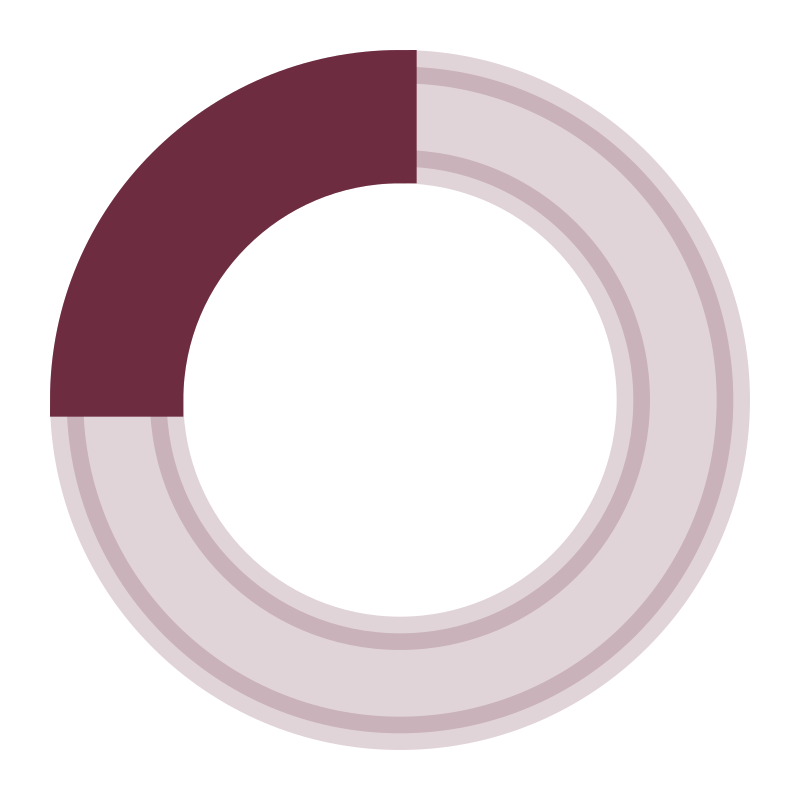
Just as the waves of change sweep across the landscape, a monumental evolution is taking place within the Solana blockchain ecosystem, making waves particularly in Europe. Recent data from Glassnode reveals an astonishing fact: a striking 67% of the blocks being produced in the current epoch hail from validators concentrated primarily in Europe, with Frankfurt at the forefront. This assembly of validators in one geographical location invites pressing inquiries about how such proximity might affect both high network performance and the essential tenet of decentralization.
Delving into the dynamics of Solana reveals the rapid succession of validator leadership, cycling every 1.6 seconds—a tempo that mandates lightning-fast connections. Herein lies the advantage of European validators. They boast an enviable average latency of 72 milliseconds from Frankfurt, starkly lower than the 140 milliseconds characteristic of the U.S. East Coast. This geographical edge translates into favorable transaction processing speeds, creating a palpable advantage for those leveraging Solana’s formidable blockchain capabilities for trading activities or decentralized applications.
Utilizing a proof-of-stake design, Solana’s infrastructure puts a premium on validator positioning, which directly influences transaction velocity and overall efficiency. Although Europe currently holds the lion's share of validator activity, there’s no reason to believe this trend seals a fate of centralization. Validator roles will continually shift with each epoch, safeguarding diversity that ensures resilience within the network’s framework. That said, developers and institutional stakeholders must remain astute to the ramifications of localized validator clusters. For latency-driven applications—think decentralized exchanges or active market-making firms—the advantage of geographic proximity to high-performing nodes can bolster transaction dependability.
As we analyze the domain of Solana, we encounter a complex balancing act: the drive for speed deftly entwined with the necessity for decentralization. While a concentration of validators can lead to enhanced efficiency, it undeniably raises alarms about the specter of centralized governance. Notably, Solana's Nakamoto coefficient hovers around 20, illuminating a potential vulnerability rooted in this clustering. It is crucial to foster a broad distribution across various locales to ensure the network's robustness. As the demands of the system elevate with each epoch, cultivating geographical diversity among validator distributions is paramount for preserving the very essence of the network’s integrity.
In this burgeoning ecosystem, developers and institutional players must act decisively to mitigate centralization risks. Enhancing Remote Procedure Call (RPC) routing emerges as a practical solution, enabling applications to reap the rewards of heightened performance without jeopardizing governance integrity. By establishing a solid foundation for infrastructure monitoring and access optimization, responsiveness can reach new heights, benefiting every user within the network.
The ethos of infrastructure diversity must be woven into the fabric of decentralized governance, ensuring that extraordinary transactional efficiencies are not achieved at the expense of fundamental principles. The future trajectory of the Solana blockchain stems from finding a delicate equilibrium between rapid transaction speeds and the tenets of decentralization that constitute its core identity.
As the Solana landscape continues to morph and adapt, a robust examination of validator distribution and its reverberations on network performance becomes undeniably essential. The recent spike in European validator engagement serves as a clarion call to scrutinize how geographic clusters impact the sanctity of decentralization. Institutions and developers alike must forge a path that harmonizes transaction efficiency with the steadfast integrity of the blockchain. Through advancing infrastructure monitoring and cultivating a broader validator network, the Solana ecosystem stands poised to cement its reputation as a resilient, high-performance platform where speed and decentralization can coalesce.
The horizon gleams with promise for Solana, but realizing its potential will require nimble navigation through the intricate interplay of decentralization and performance—challenges that will indubitably sculpt its legacy for the years to come.