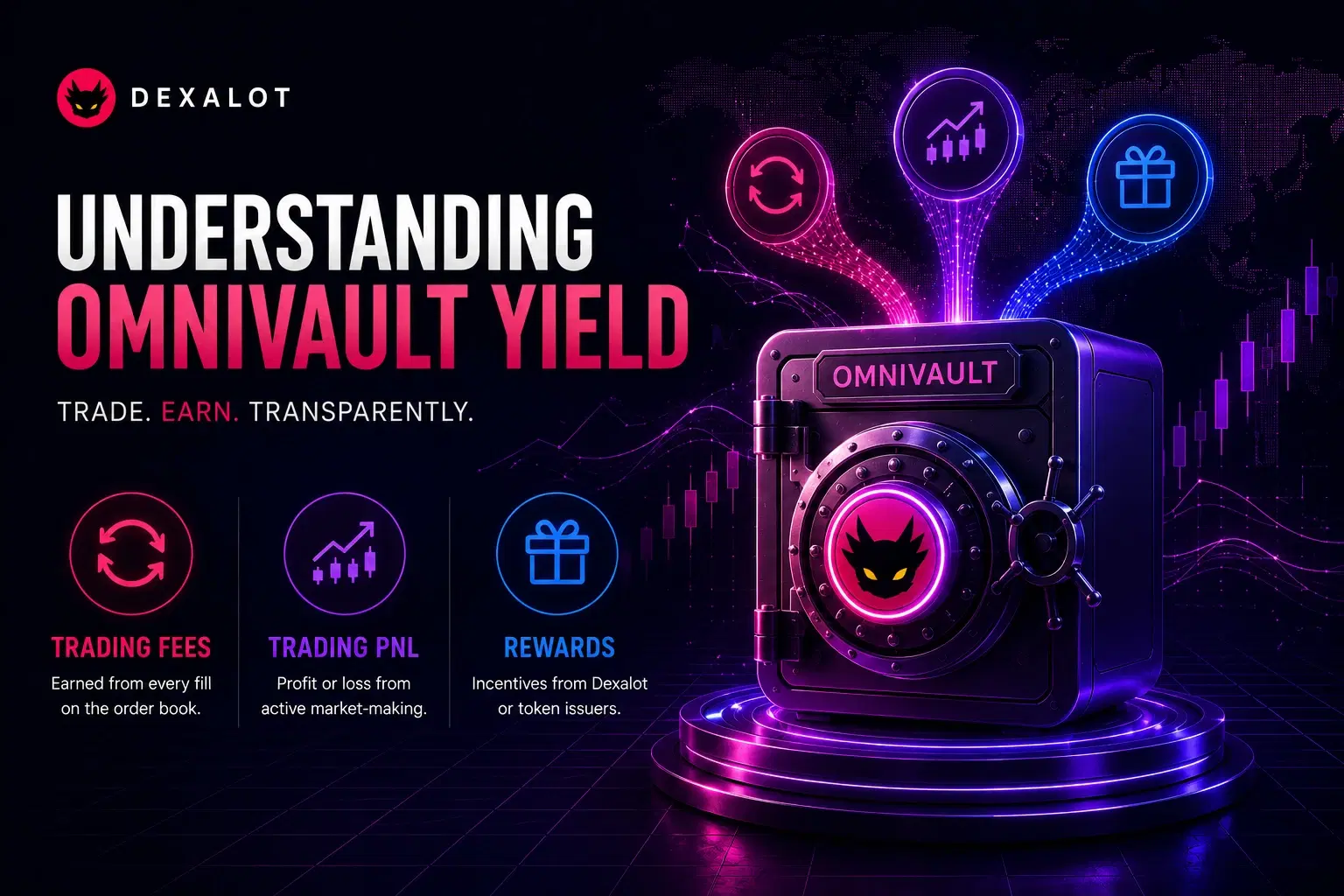


OmniVault yield breaks down into three mechanically distinct components — trading fees, market-making PnL, and discretionary rewards — and understanding which is which is how an LP separates sustainable returns from temporary subsidies.
You deposit into a vault. You wait. Numbers go up. But how, exactly? And from where?
For most DeFi LPs, the answer to “where does my yield come from?” is some mix of trading fees, token emissions, and a vague sense that the protocol is doing something on their behalf. This vagueness has a cost. It makes it hard to compare yield sources, hard to predict what happens when emissions dry up, and hard to distinguish real economic returns from inflationary handouts.
This post is the unvague version for OmniVaults. There are three sources of return, they are mechanically different, and a depositor who understands them can evaluate any OmniVault — or any future liquidity vault — in a more rigorous way than “the APR looks good.”

When you deposit into an OmniVault, your share of the pool earns yield from three distinct sources:
All three accumulate in the vault and increase the underlying value of every OmniVaultShare proportionally. There’s no separate claim process for fees vs PnL vs rewards; they all flow into the same pool and your withdrawal price reflects the sum.
But mechanically, they come from very different places. Understanding the distinction is what separates a thoughtful LP from a yield-chaser.
Every trade that matches against the OmniVault’s resting orders on the Dexalot L1 order book pays a fee. A portion of that fee flows back to the vault, distributed pro-rata across all share holders.
This is the cleanest yield source. It is paid by other market participants in exchange for the vault providing liquidity at a price they wanted to trade at. It scales with volume: more activity in the pair means more fills means more fees. It is also durable, in the sense that it doesn’t depend on emissions, token printing, or any specific incentive program continuing to run.
The closest analogue from the AMM world is the swap fee paid to LPs in a Uniswap or Curve pool. The difference is what generates those fees. On an AMM, every swap pays the LP regardless of whether the swap was a good trade for the pool. On a CLOB, the vault chooses where to rest its orders. That choice is what determines whether the vault gets filled by informed flow or by uninformed flow — which directly affects the second source of yield.
Trading fees are the most predictable component of OmniVault yield. They are roughly proportional to the volume in the pair and the vault’s share of total liquidity.
This is the source most LPs underestimate, and it is the one that most clearly distinguishes a CLOB-based vault from an AMM pool.
OmniVaults are not passive liquidity. The vault places limit orders on both sides of the book, algorithmically adjusts those orders based on signals from CEX and AMM price feeds, and aims to capture the bid-ask spread on flows it considers favorable. When the market makes the moves the vault’s strategy is positioned for, the vault realizes profit. When it doesn’t, the vault realizes loss.
This is, plainly, active market making. Whether it generates positive or negative PnL over a given period depends on:
This is structurally different from impermanent loss on an AMM. AMM IL is a deterministic outcome of price moving against the pool, with no opportunity for the LP to position around it. OmniVault PnL is the result of active decisions, which means it can be positive on average if the strategy is sound — or negative if it isn’t. The distinction matters: it isn’t a tax the LP pays in exchange for fees; it is its own line item that can go either way.
For a depositor, the practical implication is that headline trading fee APR understates the picture in either direction. Two OmniVaults with identical fee APRs can produce meaningfully different total returns based on how each one’s market making strategy performs against the flow it sees.
Rewards are the discretionary layer. They are paid out by the Dexalot protocol or by the project that listed the token in the vault, denominated in either Dexalot’s native token or the project’s own.
Rewards exist for a real economic reason: bootstrapping. A new vault on a new pair has no organic flow on day one. Liquidity providers need a reason to seed liquidity before the volume arrives. Rewards bridge that gap. They subsidize early LPs, which produces depth, which attracts traders, which generates fees and PnL, which eventually makes the vault self-sustaining without subsidy.
Rewards are the highest-variance component of yield. They can be substantial in the early life of a vault and taper off as organic activity grows. They depend on programs that the protocol or token issuer can change or end.
A useful exercise for any LP evaluating a vault is to mentally separate the headline APR into two components: what would I earn without rewards? and how much of the current APR is the reward layer? The first number tells you what the vault looks like at steady state. The second tells you how much of the current return depends on a program continuing.
Neither number is bad. A high reward share early is normal. But understanding which is which prevents the common LP mistake of treating reward-heavy APR as permanent and being surprised when emissions taper.
Concretely, the OmniVault calculates the value of each OmniVaultShare at each settlement. The share price is, in essence:
Total vault assets ÷ total shares outstanding
Total vault assets includes the base and quote tokens currently in the vault, plus any pending rewards, plus the value of any inventory across spoke chains. All three yield sources flow into this number:
Because the share price tracks the total assets, your individual yield as an LP is the appreciation of your shares between deposit and withdrawal. You don’t claim fees, PnL, or rewards separately. They all show up in the same number.
This is part of what makes OmniVaults simpler to use than running a market-making strategy directly: you don’t have to track fee accruals, mark-to-market positions, or unclaimed rewards as separate line items. The share price does the accounting.
The framework gives you four questions to ask about any OmniVault before depositing.
1. What’s the volume? Trading fees scale with volume. A pair with $50M/month in volume will produce meaningfully more fees per dollar of liquidity than a pair with $500k/month. Look at the order book, look at the trade history, look at the aggregator routing share.
2. What kind of flow does the vault see? Aggregator and retail flow is generally vault-favorable. Pairs that are mostly traded by arbitrageurs against a deeper CEX market are harder to make money on. The composition of the flow drives the PnL component.
3. How much of the APR is rewards? Separate the steady-state return (fees + PnL) from the discretionary layer (rewards). The first is what you get at scale. The second is what you get now.
4. What’s the vault’s history? A vault that has been running for months has visible track record on each of the three components. A vault that just launched is closer to a bet on the strategy than a deposit into a known yield source.
These four questions don’t give you a single APR number, but they give you something better: a structured way to compare two vaults that both advertise “15% APR” and figure out which one you actually want exposure to.
Yield in DeFi is rarely a single thing. When a protocol advertises an APR, that number is almost always a sum of components that behave differently, have different sources, and respond to different conditions. The LP who internalizes that gains a real advantage: they can pick the vaults where the yield mix matches their thesis, and they can evaluate whether a given return is sustainable or is a temporary subsidy in disguise.
OmniVaults make the three sources visible because they are mechanically separable: trading fees come from fills, PnL comes from market-making outcomes, rewards come from incentive programs. The share price aggregates them, but the underlying components are real and trackable. That transparency is a feature.
Yield on OmniVaults isn’t magic. It is paid trading fees, profit from active market making, and discretionary rewards. Knowing which is which is how you decide whether the number on the front page is worth showing up for.